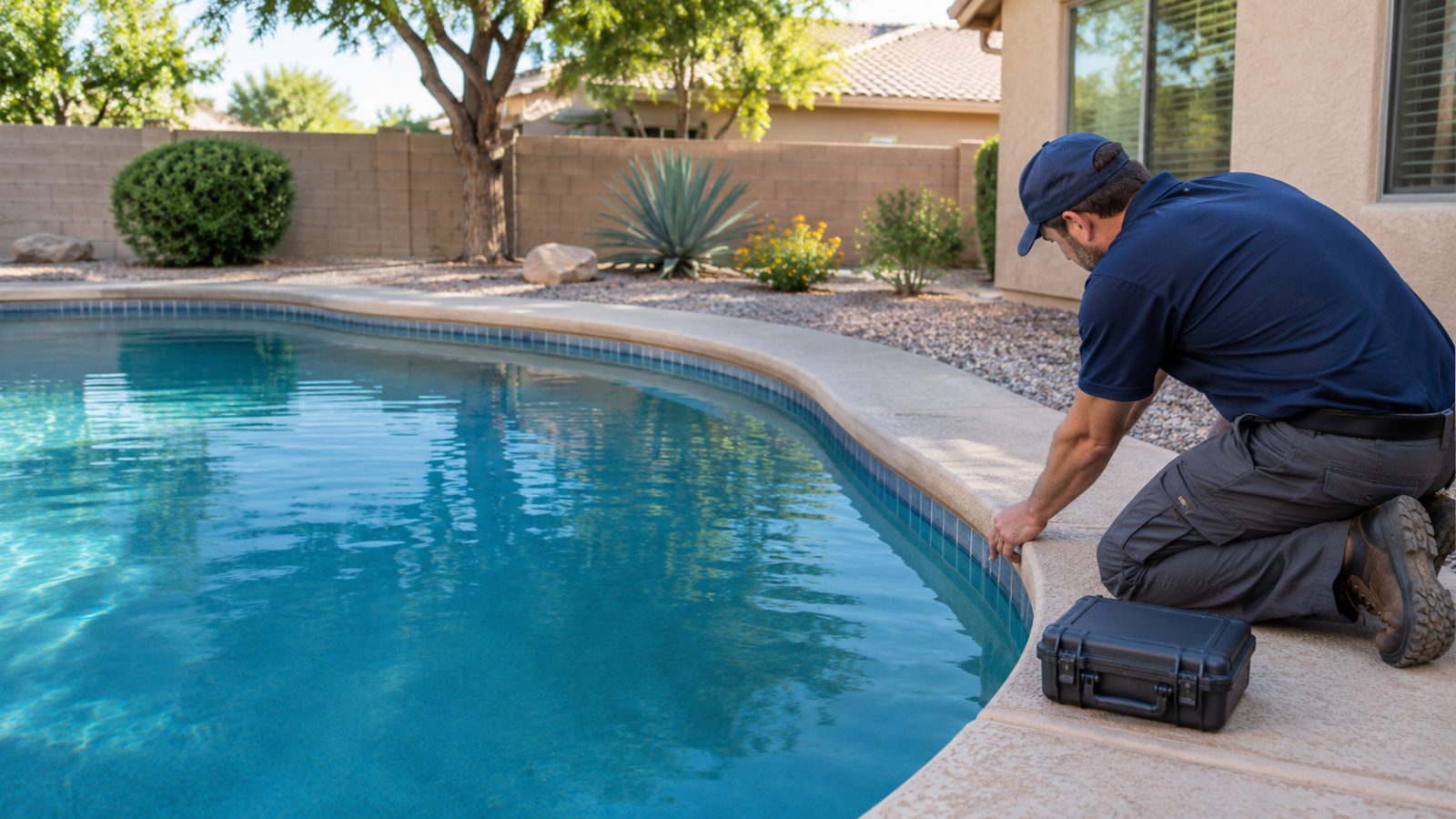
Underground Pool Plumbing Diagnostics
Underground Pool Pipeline Pressure Testing
Find out whether your buried pool lines are leaking. Get a Free Estimate
Underground Pool Plumbing Diagnostics
Find out whether your buried pool lines are leaking. Get a Free Estimate
A large part of your swimming pool's plumbing may be hidden beneath the deck, patio, landscaping, or yard. When a buried pipe develops a leak, you might notice an unexpected increase in water usage, wet soil, unexplained water loss, or changes in how the pool circulates. The visible signs do not always tell you which underground line is responsible.
Pool Leak Detection Chandler offers underground pipeline pressure testing to help investigate suspected plumbing leaks. The purpose is to isolate appropriate lines and evaluate whether they hold pressure under controlled test conditions. A failed pressure test can indicate a problem in the tested section, but additional investigation may be needed to identify the exact location. We focus on giving property owners useful information before excavation or repair decisions are made.
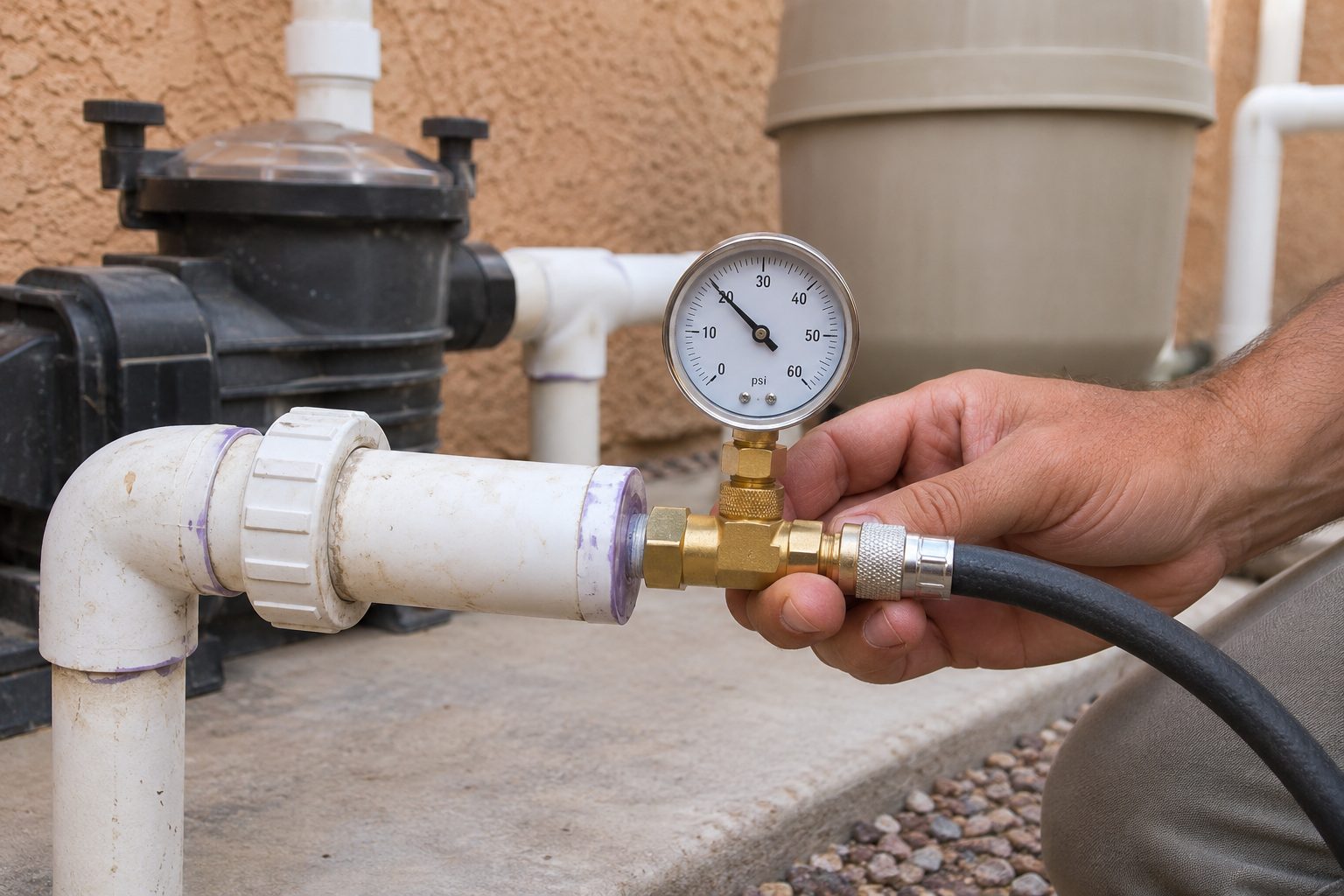
Pressure testing is especially useful when the symptoms suggest a plumbing leak but the pipe cannot be inspected directly. Swimming pools commonly use separate lines for suction, returns, spas, water features, and other functions. A problem in one circuit does not automatically mean the rest of the system needs repair. Our approach begins by understanding the plumbing arrangement, identifying accessible connections, and deciding which lines are appropriate to test. The equipment configuration, valve positions, pipe materials, and condition of the system all affect the testing procedure. We use the results to narrow the investigation and discuss how much confidence the findings provide.
Return lines carry filtered water from the equipment back into the swimming pool. When a return line leaks underground, water loss may become more noticeable while the circulation pump is operating, although that pattern is not conclusive on its own. Return fittings, connections, and buried sections can all require evaluation. We assess the accessible configuration and isolate appropriate sections for testing. If the line cannot maintain pressure, we explain the possible implications and whether the next step should involve additional localization testing. The goal is to understand the problem before opening decking or landscaping.
Suction plumbing draws water from skimmers and other pool intakes toward the pump. Leaks in these lines can sometimes introduce air into the circulation system or interfere with pump priming. The symptoms depend on whether the equipment is running, where the defect is located, and how the plumbing is configured. Suction systems require careful handling because they are connected to important pool safety features. We evaluate the testing requirements and avoid treating an air-related symptom as proof of a particular leak. Pressure testing can help determine whether an isolated line has a loss of integrity.
Pools with attached spas, waterfalls, fountains, and other water features often contain additional plumbing circuits. Water may move between connected systems, making the source of loss harder to understand without isolating the relevant components. A spa that drains down after the pump stops, for example, may also involve valve behavior rather than an underground leak. We examine the system arrangement before testing. The objective is to distinguish normal or abnormal water transfer from actual plumbing leakage and investigate the specific circuit that appears to be involved.
A pressure test provides evidence about a line's ability to maintain pressure under the chosen test conditions. A changing reading can have several explanations, including leakage, temperature changes, trapped air, or an issue with the test setup. Reliable interpretation requires attention to these variables. We explain the results without promising more certainty than the test supports. If a line appears compromised, further localization methods may help determine where repair access is needed. Pressure testing is a diagnostic tool, not an automatic instruction to excavate.
When a buried pipe is confirmed to be leaking, the repair plan depends on its location, accessibility, surrounding materials, and overall condition. Some issues may be addressed through targeted access to a connection or short pipe section. Others may justify replacing or rerouting part of the line. We discuss the options in practical terms, including the potential effects on decking, landscaping, and nearby features. Our objective is to help customers understand why a particular repair approach may be appropriate before disruptive work begins.
| Service | Estimated Cost | Average |
|---|---|---|
| Single accessible plumbing circuit | Quoted after review | No fixed average |
| Multiple pool plumbing circuits | Based on number of lines | No fixed average |
| Pool and attached spa testing | Custom scope | No fixed average |
| Further leak localization | Additional quote if needed | No fixed average |
Testing costs vary with the number of circuits, available isolation points, system complexity, and access. Excavation and pipe repairs are separate considerations unless expressly included in a written scope.
We believe buried plumbing should be evaluated carefully before disrupting a deck or yard.
Separate plumbing circuits can have different conditions. Isolating the likely problem helps avoid treating the whole system as defective.
We explain what a pressure result means and whether further testing is needed to support a repair decision.
We consider access limitations, landscaping, and surrounding surfaces when discussing repairs.
Worried about a buried pool pipe? Explain the symptoms and request a pressure-testing assessment.
Free — no obligations
We discuss water loss, air in the system, damp ground, circulation changes, and relevant pool history.
We review the accessible system and determine which lines can be isolated and safely tested.
Appropriate test equipment is used according to the plumbing configuration and condition.
We review pressure changes and consider factors that may affect the results.
If a line appears to be leaking, we discuss whether further localization or a repair assessment is appropriate.